Echoes of the Blade
On this page
Filipino Martial Arts is more than a system; it is an expression of the Philippines' rich cultural heritage and adaptability. Many of the styles that make up FMA have evolved over centuries, being shaped by the country's diverse history and the social shifts that its people have faced.
FMA techniques are often passed down through oral traditions, deeply connected to Filipino values such as adaptability, community, and respect. As FMA gained global recognition in the 20th century, it became a symbol of Filipino identity, showcasing the nation's ability to integrate diverse influences while maintaining its cultural essence.
Islands of conflict and culture
What we now call the Philippines is actually an archipelago of 7,641 islands shaped by diverse influences. The culture, traditions, and even language of the islands differ, with over 170 languages being used across the archipelago.
Its earliest history, from a global perspective, illustrates thriving indigenous communities with trade links to China, India, and Southeast Asia. Ferdinand Magellan, a Portuguese explorer, arrived in 1521, sailing under a Spanish flag. This marked the start of colonization in 1565 by the Spanish, who ruled for over 300 years, integrating their culture and governance. During this time, Christianity became the dominant religion of the Philippines.
In 1898, the Philippines declared independence. However, due to this coinciding with the Spanish-American War, control transferred to the United States. The impact of American rule was Western education and further development of the infrastructure.
The Filipino aspirations for self-governance did not wane, but grew. Unfortunately, World War II brought a brief occupation by Japan, resulting in widespread devastation. However, in 1946, the Philippines became a republic, gaining full independence.
The decades that followed brought struggles, including the dictatorship under Ferdinand Marcos (1965 to 1986), sparking the People Power Revolution. This was a peaceful uprising that resulted in the restoration of democracy. Since then, the republic has experienced economic growth, natural disasters, and many political transitions.
Today, the Philippines is known as a vibrant nation of diverse cultures, languages, and traditions. Across all of this, the Filipino people have shown themselves to be both resilient and hospitable. Their history embodies a struggle for self-determination while being shaped by foreign powers; throughout all of it, though, their spirit has remained unyielding.
Birth of a warrior's art
The Filipino Martial Arts is a rich set of styles and techniques that have evolved over time, intertwined with the cultural and historical evolution of the Philippines. Given that the Philippines comprises 7,641 islands speaking over 170 languages, it is no surprise that there is not a single origin to FMA. In fact, if you look at the different styles, you will find a diversity that parallels its many islands. We can, however, group the history of FMA and each style into four distinct phases of evolution.
- Pre-colonial origins. Many of the styles that are now under the umbrella of FMA originated as combat systems developed by the indigenous Filipino tribes. As they were focused on survival and warfare, these styles are very practical, utilizing hand-to-hand, stick, and blade techniques. The styles did not evolve in isolation. Across the Visayas, Mindanao, and Luzon, distinct systems and tactical nuances emerged, shaped by the terrain, available weapons, and intertribal conflict. This regional variation is a hallmark of FMA's adaptability.
- Spanish colonial period. The many islands that make up the Philippines were mostly independent prior to the arrival of the Spanish. During colonization, the practice of FMA was suppressed. Consequently, the Filipinos utilized cultural performances such as Moro-Moro plays to disguise their martial arts traditions.
- American colonial period and World War II. During this period, FMA further evolved to adapt to modern combat scenarios. Many Filipino guerrillas used the martial arts of their family systems to effectively resist the occupying Japanese armies. In the postwar period, as Filipino masters emigrated or interacted with foreign systems, there was a shift from purely combative training toward more structured pedagogy. Demonstrations, competitions, and integrated drills began shaping the way FMA was shared without compromising its core survival ethos.
- Modern revival. During the 20th century, FMA expanded to the global stage, thanks to practitioners like Remy Presas and Dan Inosanto, as well as its popularization in Hollywood films. Subsequently, FMA communities spread worldwide.
As a result of this evolution, many FMA styles are more than a combat system; they embody the cultural heritage of the Filipino people, its resilience and adaptability. For this reason, as we dive into Dekiti Tirsia Siradas, these themes, along with leadership, strategy, and personal growth, will all emerge.
Grandmaster Antonio Ilustrisimo, Founder of Kalis Ilustrisimo, once said, "My style was developed on the streets and in the war, not in the gym. Real fights leave no room for fantasy." His words reflect how historical conditions shaped not just tactics, but the spirit of FMA itself.
Tools of survival
Filipino weapons include the double stick, sword, axe, single stick alone or with dagger or shield, double knife, single knife and empty hands, short stick, flexible weapons, throwing weapons, archery and blowgun, spear, staff, and double handed long stick. And, of course, blades.
Krises are a well-known blade and have three or more odd numbered waves in the blade. This weapon is double-edged and designed for thrusting. DTS is most known for its use of the ginunting and the talibong, native swords of the Negros area. The ginunting is a traditional Visayan sword with a forward-curving blade. Its blade design, resembling a beak, allows for efficient chopping, hooking, and slashing movements. The talibong is a single-edged slightly forward-curving sword traditionally used in the Visayas region. It has a leaf-shaped or tapering blade. The talibong is considered a precursor or variant of the bolo and shares similarities with the ginunting but usually has a simpler, less hooked profile.
Living legacy
FMA has evolved into a globally recognized discipline, celebrated for its practicality, adaptability, and cultural soul, yet its story is not simply about techniques, ranks, or titles. It is the story of a people who, across centuries, refused to let their spirit be conquered.
In the Philippines, FMA holds a sacred place, not only as a martial art, but as a reflection of resilience, creativity, and identity. Arnis was officially declared the national martial art and sport in 2009, honoring generations of Filipinos who preserved these traditions through colonization, war, and modern upheaval. Today, Grandmasters are celebrated not merely for skill, but for safeguarding living history, lineages of movement and survival that reach back long before formal nations existed.
Across islands and regions, Luzon, Visayas, Mindanao, Cebu, and Negros, FMA evolved differently, shaped by terrain, necessity, and circumstance. Blade arts developed in some regions, stick and hand-to-hand skills in others. Styles were not practiced for trophies; they were forged to protect family, clan, and homeland against pirates, invaders, and rival factions. This diversity within unity remains one of FMA's greatest strengths.
In the modern world, FMA has expanded far beyond Philippine shores. Schools flourish across the Americas, Europe, and Asia. Hollywood films like the Bourne series and John Wick introduced millions to the fast, fluid movements of Filipino fighting arts, but beyond the screen, the practicality and realism of FMA have drawn serious martial artists deeper into its study.
FMA continues to adapt and thrive. It lives not only in bladed sparring and stick fighting, but also in self-defense, law enforcement tactics, fitness programs, and sport Arnis competitions. Modern practitioners explore traditional drills alongside new innovations, proving that an art born in the jungles and fields of a scattered archipelago remains relevant even in the digital age.
The legacy of FMA is a living echo, heard in the clash of sticks, seen in the rhythm of movement, felt in the discipline of those who train. To study it is to enter a lineage of survivors, innovators, and warriors, and to carry forward a tradition not frozen in time, but alive in every step, every strike, and every choice to endure.
Currents of the Blade
The story of Filipino Martial Arts is not the story of one art alone, but of many branches shaped by geography, necessity, and the creativity of their practitioners. From the northern plains of Luzon to the central islands of the Visayas and the southern reaches of Mindanao, systems developed in response to local conditions, coastal raiding, inter-island rivalry, resistance to colonization, or the day-to-day need to defend family and livelihood. Each region left its imprint: Luzon with its blend of indigenous and Spanish fencing traditions, Cebu and the Visayas with their blade-centered duels and family schools, and Mindanao with its Moro warrior culture, where edged weapons remained a living reality.
As centuries passed, these regional systems did not remain static. They adapted to new weapons, absorbed outside influences, and, in the 20th century, found expression in organized schools and named systems. Some masters emphasized the elegance and precision of blade arts, others the stripped-down realism of close-quarters stick fighting, and still others sought to build structured curriculums to preserve knowledge for future generations. This evolution produced the diversity we see today: Modern Arnis, Kombatan, Kalis Ilustrisimo, Doce Pares, Balintawak, Lameco, Pekiti-Tirsia, San Miguel Eskrima, and many more.
Yet, despite their differences, these systems are bound by a common thread. All reflect the Filipino principles of adaptability, efficiency, and survival. All value the ability to translate movement between weapon and empty hand. And all carry within them the echoes of the same history, an art born of necessity, tested in conflict, and carried forward as both cultural heritage and practical defense.
It is within this broader landscape that Dekiti Tirsia Siradas finds its place. DTS is not an isolated branch, but part of the living forest of FMA. To understand its depth is also to appreciate the soil from which it grew, the resilience of a people, the diversity of their islands, and the many masters whose arts continue to shape the identity of Filipino Martial Arts around the world.

A Broader Blade
Filipino Martial Arts, encompassing systems like Arnis, Eskrima, and Kali, is renowned for its emphasis on weapon-based combat, adaptability, and efficiency. While Dekiti Tirsia Siradas is a prominent system, and the focus of this book, understanding its place within the broader FMA landscape enriches appreciation for its techniques and philosophy.
This appendix summarizes a few key styles from the Luzon and Visayan regions that have developed alongside DTS.
Visayan Region
The Visayan islands are often described as the heartland of Arnis, a region where stick and blade traditions were refined into structured systems that continue to define FMA today. The Visayas produced some of the most prominent masters and organizations, and its cities became fertile ground for innovation and rivalry that pushed the art forward. From well-known schools in Cebu to family systems preserved in smaller provinces, Visayan styles carry a balance of practicality and cultural identity. They reflect the region's long history of maritime trade, conflict, and community defense, producing arts that are as diverse as the islands themselves. Many of the systems that achieved national and international recognition trace their roots back to the Visayas, underscoring its central role in the evolution of Filipino martial arts.
Hinigaran
From the Hinigaran region of Negros Occidental emerged one of the most influential families in the history of Filipino Martial Arts: the Presas brothers. Remy, Ernesto, and Roberto each carried forward the traditions of Arnis while also reshaping and reinterpreting them for new audiences. Collectively, their work did more than preserve a regional art - it projected Arnis onto the global stage, ensuring that the Filipino martial heritage would not only survive but thrive in the modern era. Though each brother followed his own path, their combined contributions have created a legacy that continues to inspire practitioners around the world.
Modern Arnis
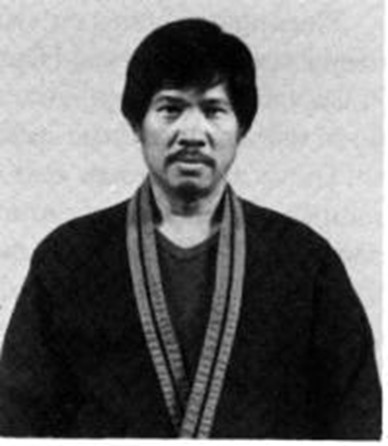
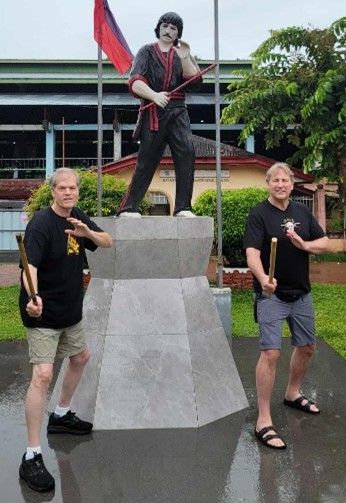
Modern Arnis was founded by Remy A. Presas in the 1950s with the goal of preserving traditional FMA while modernizing it and making it more accessible to a broader audience. Often credited as the "Father of Modern Arnis," Presas sought to unify various FMA styles and integrate them with practical self-defense concepts suited for both armed and unarmed applications.
Originally developed in Hinigaran, a short distance from Bacolod on the island of Negros Occidental - the same island central to DTS. Modern Arnis emphasizes flow drills (such as sinawali and tapi-tapi), stick and blade work, disarming techniques, and empty-hand applications. Its structured curriculum makes it an ideal entry point for beginners while still offering depth for advanced practitioners.
A hallmark of Modern Arnis is its seamless transition between weapons and empty-hand techniques. The principle of "weapon to empty-hand translation" allows practitioners to convert strikes, blocks, and locks from stick to hand, making the system directly relevant to self-defense in modern contexts. Remy Presas also incorporated joint locks, pressure points, and grappling elements, blending them into a distinctly Filipino framework of striking and flow.
After moving to the United States in the 1970s, Presas became a driving force in the global recognition of FMA. He taught seminars worldwide, certified instructors across multiple continents, and established Modern Arnis as both a martial system and a cultural ambassador, eventually seeing it included in university programs in the Philippines and abroad.
Today, multiple branches of Modern Arnis exist, from the International Modern Arnis Federation to organizations led by his students and family. Despite differences in emphasis, all Modern Arnis systems preserve Presas's vision of practicality, adaptability, and cultural continuity.
In shaping a modern framework while safeguarding tradition, Remy Presas ensured that Arnis would not only survive but thrive - standing as one of the most visible and influential FMA systems worldwide.
Kombatan
Kombatan is a comprehensive FMA system founded by Ernesto A. Presas, the younger brother of Remy Presas. While the two brothers shared roots in traditional Arnis and collaborated early in their careers, Ernesto evolved Kombatan into a distinct system that emphasizes a broader technical base, diverse weapons integration, and combative applications.
Developed in the 1980s under the International Philippine Martial Arts Federation (IPMAF), Kombatan fused techniques from traditional Filipino systems such as Arnis de Mano and Kuntao with influences from Jujutsu, Karate, and other external styles, creating a holistic and battle-ready curriculum.
What sets Kombatan apart is its extensive weaponry base. Training spans single stick, double stick (doble baston), knife, espada y daga, staff (bangkaw), palm stick (dulo-dulo), and flexible weapons such as the sarong or belt. Empty-hand training is equally emphasized, with mano-y-mano, dumog, and striking methods directly translating from weapon to hand, reinforcing adaptability across ranges.
The system also retains a form-based structure (anyo), preserving traditional movements while developing coordination, power, and rhythm. From there, students transition into combat drills and live application, balancing heritage with realism.
After Ernesto Presas's passing in 2010, Kombatan continued under his son Ernesto "Jun" Presas Jr. and senior masters, gaining international recognition across North America, Europe, Asia, and Australia. Practitioners regularly participate in tournaments and exhibitions, helping sustain FMA visibility on a global scale.
Through its breadth of weapons, emphasis on adaptability, and blend of tradition and innovation, Kombatan stands as one of the most complete FMA systems, complementing arts like DTS while offering practitioners a wide-ranging arsenal and philosophy for modern practice.
Arjuken
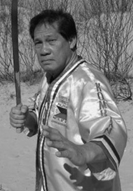
Roberto Presas, the younger brother of Remy and Ernesto, also left his mark on the Filipino martial arts through the development of Arjuken - a system whose name reflects its composite roots: Arnis, Jujutsu, and Kendo or Karate. While less widely known internationally than Modern Arnis or Kombatan, Arjuken represents Roberto's unique vision of combining traditional Filipino martial principles with influences from Japanese and other martial arts to create a system both practical and accessible.
Trained alongside his brothers in the family’s home region of Hinigaran, Negros Occidental, Roberto shared the same foundation in classical Arnis. Where Remy focused on structuring and promoting FMA as a modernized national art, and Ernesto emphasized weapons breadth and combative application, Roberto carved his own path by stressing adaptability across cultures. His Arjuken system incorporated traditional stick and blade work, joint locking and throwing techniques inspired by Jujutsu, and striking methods influenced by Karate and other systems. This cross-training orientation made it appealing to students who wanted both Filipino tradition and exposure to international martial concepts.
Arjuken practice emphasizes practical self-defense, bridging empty-hand and weapon-based responses in a way that mirrors the Filipino principle of translation between ranges. Training typically includes single and double stick work, bladed applications, joint manipulation, throws, and striking drills, giving practitioners a diverse foundation. While the system preserves many FMA mechanics, its blended structure reflects Roberto's openness to innovation and cultural exchange.
Though Roberto did not pursue the same level of global outreach as his brothers, his contributions carry weight in the Philippines and among practitioners who seek a hybrid approach to martial practice. His efforts have ensured that the Presas legacy is not defined solely by Modern Arnis and Kombatan, but also by a more eclectic system that reflects the adaptability and evolving spirit of FMA.
Through Arjuken, Roberto Presas demonstrated the versatility of Filipino Martial Arts, proving that its principles could be fused with outside influences while still maintaining a distinctly Filipino identity.

Cebu
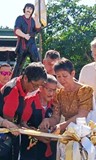
Cebu has long been recognized as one of the great centers of Filipino martial development. In the 20th century, it became a crossroads where masters from different regions exchanged knowledge and forged new systems, blending traditional blade work with evolving stick and self-defense methods. From this environment came some of the most influential organizations and styles in FMA, including Doce Pares and Balintawak. Each reflects the spirit of Cebu - innovative, adaptive, and committed to preserving the heritage of Arnis while preparing it for modern practice.
Doce Pares Eskrima
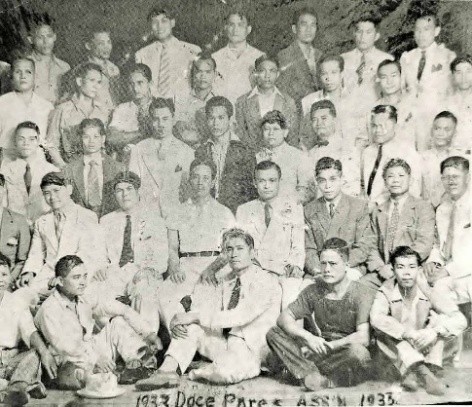
Founded in 1932 in Cebu City, Doce Pares is one of the oldest and most influential FMA organizations. Its name, Spanish for "Twelve Pairs," pays homage to both its twelve founding masters and the legendary twelve warriors of Charlemagne, linking FMA heritage with global warrior mythology.
Doce Pares was established by a collective of masters, most notably Eulogio "Yoling" Canete and Lorenzo Saavedra, with the mission of preserving, developing, and promoting Eskrima in the Visayas region. The system they created was eclectic from the beginning, incorporating techniques from multiple lineages and emphasizing a blend of long, medium, and close-range fighting. Over the decades, Doce Pares has evolved into a comprehensive system that includes single stick, double stick, sword, knife, empty-hand, grappling, and ground fighting.
A key feature of Doce Pares is its layered curriculum. Beginners typically start with the twelve striking angles and sinawali (double-stick weaving patterns), then progress into more advanced drills such as corto (close-range combat), disarms, and lock-and-throw sequences. Over time, practitioners also explore mano-y-mano (empty-hand applications) and dumog (Filipino wrestling), making it a versatile and well-rounded system.
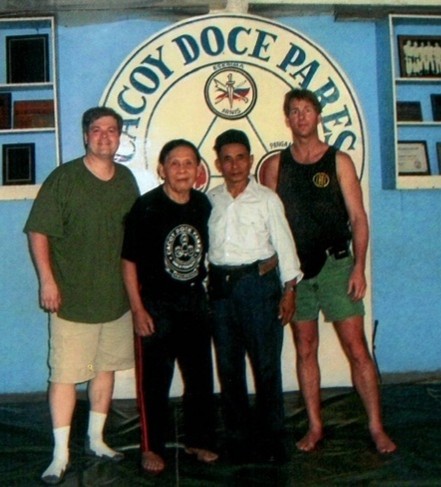
In the 1980s, Ciriaco "Cacoy" Canete, one of the last surviving founding masters and a legendary figure in his own right, developed a specialized branch known as Doce Pares Eskrido. This sub-style integrates Eskrima with elements of Judo, Aikido, and traditional dumog, emphasizing joint locks, throws, and live grappling during weapons encounters. Cacoy remained active into his nineties, famously demonstrating throws and disarms well into his elder years, an embodiment of the art's longevity and depth.
Doce Pares has played a pivotal role in the promotion of FMA worldwide. The organization has produced countless instructors, hosted international tournaments, and supported global seminars. Today, it has branches in Europe, the Americas, Australia, and throughout Asia. It was also instrumental in promoting Sport Arnis, helping shape the competition framework now recognized in Philippine schools and international events.
Doce Pares stands as a cornerstone of FMA history, both preserving ancient knowledge and continually evolving. Its influence is deeply felt within the FMA community, and its philosophy of integration, adaptability, and lifelong learning resonates with practitioners of all backgrounds.


Balintawak Eskrima
Balintawak Eskrima is a close-range FMA renowned for its speed, precision, and stripped-down effectiveness. Developed in the 1950s by Venancio "Anciong" Bacon in Cebu City, Balintawak was born out of a desire to focus Eskrima down to its most essential, realistic components; something that could be applied effectively in street-level self-defense and one-on-one encounters.
The system takes its name from Balintawak Street, where Bacon and his early students trained behind a barbershop in Cebu. Dissatisfied with the multi-person sparring and largo (long-range) emphasis in some contemporaneous systems, Bacon engineered a style centered on corto range - the tight, fast, often chaotic distance where split-second reactions determine survival.
Balintawak training is known for its "one-on-one" instruction model, where a teacher works directly with a student to build reflexes, timing, and flow. This method fosters sensitivity, which practitioners call "feel," enabling the defender to read the attacker's intention through minimal movement. Students learn to intercept strikes, control the line, and counter instantly, using a combination of stick strikes, checks, traps, and empty-hand applications.
A key hallmark of Balintawak is its live, reactive nature. Rather than memorizing forms, students engage in constant guided sparring, known as "play," where the teacher subtly increases speed and pressure. Over time, the student internalizes not only the twelve fundamental strikes, but also how to manage broken rhythm, deception, feints, and off-angle attacks.
Though it may appear minimal compared to more structured systems, Balintawak is deeply sophisticated in its simplicity. The style's emphasis on body mechanics, range control, and counter-timing makes it highly efficient and adaptable in real-world scenarios.
Balintawak has since splintered into various lineages, each retaining the core close-quarters philosophy, but differing in approach and curriculum. Among the most recognized successors are Nick Elizar's World Nickelstick Eskrima, Bobby Taboada's Balintawak Arnis System, and the original Balintawak Self-Defense Club. Each branch continues to promote Bacon's legacy while tailoring the system to different generations of students.
With its street-proven simplicity and refined technique, Balintawak Eskrima remains a quintessential Filipino close-combat art, highly regarded for its ability to teach economy of motion, lightning-fast defense, and internal discipline under pressure.
San Miguel Eskrima
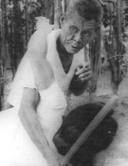
San Miguel Eskrima traces its roots to Filemon "Momoy" Canete, one of the most respected members of the Doce Pares family and a key figure in Cebuano martial heritage. While Doce Pares became known for its eclectic multi-range system, Momoy refined his personal expression into San Miguel Eskrima - a style that emphasizes classical blade movement, flowing body mechanics, and precise timing. Named after the archangel Michael, San Miguel Eskrima symbolizes both protection and decisive martial response, embodying the balance of tradition and practicality.
The system places particular focus on the bolo and stick as interchangeable weapons, with techniques that translate seamlessly into empty-hand defense. Its curriculum is characterized by angular strikes, circular deflections, and carefully structured footwork designed to create both offensive openings and defensive security. Training often includes structured drills to ingrain patterns, followed by free-flow exchanges that test timing and adaptability.
A hallmark of San Miguel Eskrima is its emphasis on form and flow. Rather than relying solely on raw speed or power, practitioners are taught to align body mechanics with weapon trajectory, producing efficiency and precision in every strike. This makes the art both combatively effective and aesthetically distinctive, preserving the traditional elegance of Cebuano Eskrima.
Lameco Eskrima
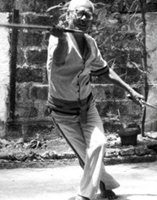
This is a dynamic and widely respected FMA system founded by Edgar G. Sulite in the early 1980s, known for its fluid integration of largo, medio, and corto range combat. The name "Lameco" itself reflects this core principle.
Sulite was born in the Philippines in 1957 and trained under some well-known FMA masters, including Leo Gaje (Pekiti-Tirsia Kali), Antonio Ilustrisimo (Kalis Ilustrisimo), Jesus Abella, and Jose Dizon (De Campo Uno-Dos-Tres). Drawing from his deep well of experience, Sulite sought to create a system that would retain traditional Filipino techniques while refining them into a highly practical street-ready martial art. The result was Lameco Eskrima: efficient, aggressive, and brutally effective across all ranges.
One of the unique aspects of Lameco is its approach to training. Sulite structured the curriculum using drills such as Laban Laro (play fighting) and Larga Mano (a style and strategy that emphasizes long-range fighting), focusing on pressure-tested techniques executed under realistic timing and conditions. Emphasis is placed on reflex development, angle recognition, economy of motion, and a seamless flow between offense and defense.
Lameco incorporates training in single stick and blade, double weapons, mano-y-mano, knife tactics, weapon disarms and counters, and grappling and limb control at close range. Drills such as Five Strikes (a basic pattern for five primary attack angles), Clock System (footwork and targeting based on clock directions), and Labang Orasan (timing and movement using a clock-face concept) help practitioners learn to engage from multiple angles and ranges with speed, accuracy, and devastating power. Sparring and full-contact application are also key parts of the system, reinforcing the core principle that drills must translate into performance under pressure.
In the early 1990s, Sulite moved to the United States and began teaching Lameco Eskrima to a growing group of martial artists. His students included well-known figures such as Dan Inosanto, Marc Denny, and members of the Dog Brothers, helping Lameco gain international recognition and respect across diverse martial arts circles.
Moified Topado
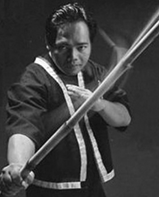
Grandmaster Mike Vasquez is a highly respected Martial Arts innovator from Negros Occidental, Philippines, known for transforming the traditional long-stick art of Tapado into a refined, scientifically-informed system he named Modified Tapado, alongside an equally impactful Modified Karate.
Vasquez began martial training early—studying Arnis de Mano with Juan Lawan and Amador Chavez, and later expanding into Judo, Jiu-Jitsu, and classical Asian weapons, including nunchaku, sai, bo, and bullwhip—crafted through a broad exploratory lens .
In the 1960s, the art of Tapado was developed by Grandmaster Romeo “Nono” Mamar in Bago City, Negros Occidental. Grandmaster Vasquez became Mamar’s only authorized protégé, empowered to spread the art globally—marking the origin of his own adapted system, Modified Tapado, which emphasizes efficiency, esoteric principles, and scientific refinement.
Modified Tapado retains Tapado’s focus on powerful long-stick technique, but integrates strategic ergonomics, advanced body mechanics, and structural alignment for a heightened level of martial economy and precision. Vasquez went further to apply the same ethos to empty-hand combat with Modified Karate, weaving techniques like simultaneous attacks and penetrating strikes into a curriculum that merges traditional power with modern execution.
His contributions also stretch into pedagogy and leadership. Vasquez authored two pioneering texts—Modified Karate: A New Concept of Advanced Karate and Fundamentals of Tapado: Arnis Long Stick Art of Fighting—which systematized his innovations and made the arts accessible to future students.
A former physical education instructor in Bacolod City, Vasquez also achieved athletic success, winning heavyweight titles and serving as head coach for the national karate team in the 1970s. He remains a key figure in martial arts advocacy, participating in events like the 2011 Senate public hearing on Arnis promotion in the Philippines Scribd .
Grandmaster Vasquez’s legacy lies in his ability to honor tradition while advancing it—turning Tapado and Karate into structured, modernized systems with both combative potency and scholarly rigor. His innovations ensure that martial culture from Negros continue to evolve, reaching new students with clarity and depth.
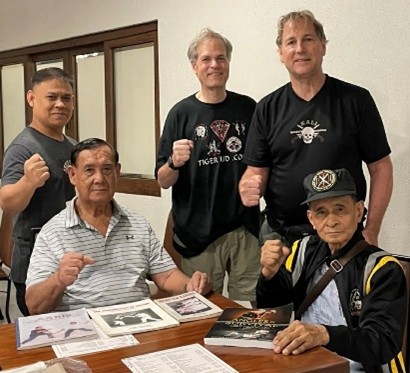
Luzon Region
As the largest and most populous island of the Philippines, Luzon has played a central role in shaping Filipino martial traditions. The region’s history of warfare, resistance, and cultural exchange gave rise to numerous systems of Arnis and Eskrima, each reflecting both local needs and outside influences. Luzon became a meeting ground where indigenous practices blended with Spanish fencing and later absorbed elements from Japanese and other martial arts. In the modern era, it has also been the birthplace of several systems that took root in the Filipino diaspora, spreading abroad while retaining their Luzon identity.
The styles that emerged here highlight both preservation of heritage and openness to adaptation, making Luzon a cornerstone of the Filipino martial legacy.
Cabales Serrada Eskrima
This was founded by Grandmaster Angel Cabales, who is often credited as one of the first to formally introduce FMA as a respected discipline in the United States. After immigrating to California in the 1930s, Cabales began teaching publicly in the 1960s, helping spark broader interest in FMA outside the Philippines.
Serrada, meaning "to close" in Spanish, refers to the system’s focus on close-range combat. Unlike styles that favor largo (long-range) stick or blade work, Cabales Serrada Eskrima emphasizes tight angles, short strikes, and rapid-fire counterattacks. The style is built on economy of motion, precision targeting, and the ability to deliver multiple strikes in confined space.
Training often begins with a strong foundation in the twelve striking angles, followed by reflex drills such as the well-known lock and block, and culminates in free-flow sparring. Footwork in Serrada is distinct, often minimal and efficient, designed to maintain structure and balance while the practitioner is operating at close quarters. The system also includes disarms, locks, and counters, typically delivered with swift, compact movement.
Angel Cabales’s influence was profound. He taught many students who would become masters in their own right, and his legacy continues today through organizations and branches of his lineage still practicing and preserving his teachings.
Cabales Serrada Eskrima stands out for its accessibility, intensity, and razor-sharp emphasis on close-in fighting, a fitting complement to systems like DTS that also operate within the deadly proximity of blade combat.
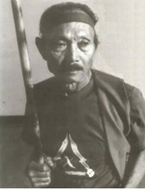
Smoking Sticks
Grandmaster Rodel "Smoking Sticks" Dagooc is widely recognized as one of the most dynamic ambassadors of Filipino Martial Arts. A longtime senior student of Remy Presas, Dagooc helped bring Modern Arnis to international audiences while also carving his own identity as a master and innovator. His nickname, "Smoking Sticks," reflects both his incredible speed with the baston and his energetic teaching style that has captivated practitioners worldwide.
Dagooc rose to prominence as part of the Modern Arnis movement under Remy Presas, traveling extensively to demonstrate the art and establish it abroad. He eventually founded his own organization, World Family of Modern Arnis (WFMA), which emphasizes both the technical foundation of Presas-style Arnis and Dagooc’s personal innovations. His teaching highlights the flow of weapon-to-empty-hand translation, rapid-fire striking combinations, and practical self-defense applications that blend stick, blade, and open-hand techniques.
What distinguishes Dagooc is not just his technical mastery but his charisma as a teacher and performer. Demonstrations of his blindingly fast sinawali, disarms, and striking combinations earned him international recognition, making him one of the most visible representatives of Filipino Martial Arts in the late twentieth and early twenty-first centuries. His approachable style and emphasis on accessibility have inspired a new generation of instructors and students to carry on the legacy of Arnis.
Today, Dagooc continues to promote FMA through seminars, workshops, and organizational outreach, ensuring that the values of discipline, flow, and adaptability remain at the heart of the art. Smoking Sticks serves not only as his personal hallmark but as a reminder of the vitality and living spirit of Filipino Martial Arts, embodying both tradition and innovation in motion.
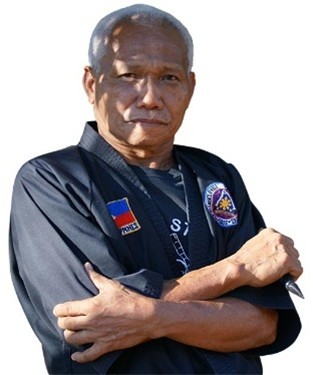
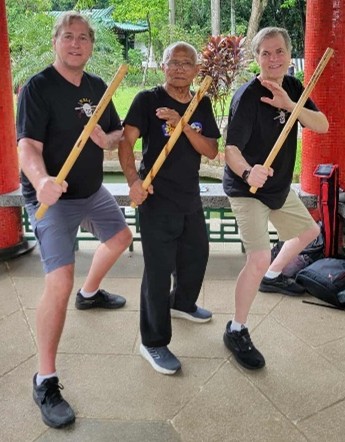
Aycocho Martial Arts
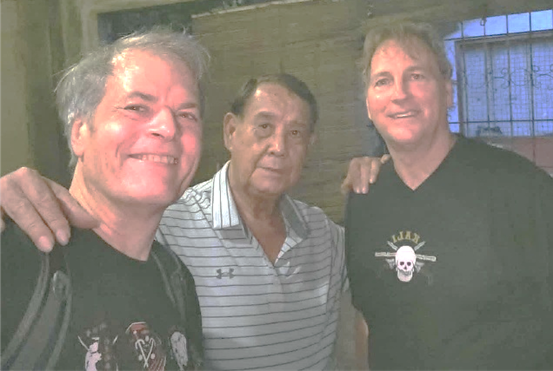
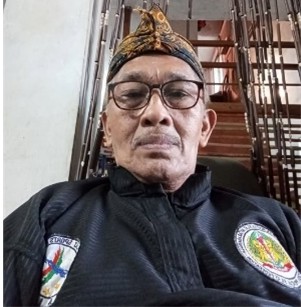
Grandmaster Francisco "Frank" Aycocho is a Metro Manila-based Filipino martial arts teacher known for blending Filipino blade and stick work with elements from Kuntaw and Silat into a practical curriculum-driven approach.
Aycocho’s system reflects the diverse martial influences found throughout Luzon, where practitioners often explored cross-training across multiple disciplines. Drawing from traditional Arnis mechanics alongside Southeast Asian striking and grappling methods, Aycocho developed a method that emphasizes practical combat application while maintaining strong technical foundations.
Training within Aycocho Martial Arts often integrates weapon work with empty-hand translation, reflecting a core Filipino martial principle that techniques should remain functional regardless of whether a weapon is present. Students train with sticks, blades, and hand-to-hand techniques that emphasize timing, positioning, and tactical awareness.
Through seminars, instruction, and international connections with practitioners abroad, Aycocho has helped extend the reach of Luzon-based Filipino martial traditions to a broader global audience. His approach reflects the evolving nature of FMA, where innovation and cross-cultural exchange continue to shape how the arts are practiced and preserved.
Kalis Ilustrisimo
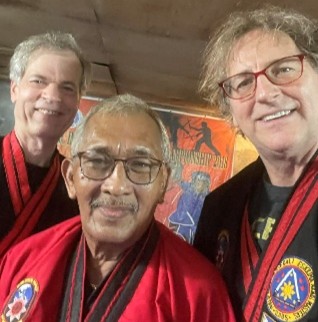
Kalis Ilustrisimo is one of the most respected bladed systems in Filipino Martial Arts, founded by Antonio “Tatang” Ilustrisimo in Manila. Unlike many arts that adapted stick-based methods for modern training, Ilustrisimo remained firmly blade-oriented, with movements and tactics designed for live combat. Tatang, who reportedly survived numerous real encounters, distilled his art into a direct, efficient, and highly practical system that emphasizes cutting angles, thrusts, and positional control.
Training in Kalis Ilustrisimo focuses on realistic blade logic. Techniques are designed with the assumption of a sharp weapon in hand, which informs its economy of motion, angular entries, and avoidance of unnecessary exchanges. Core elements include thrusts to vital targets, slashing arcs, deflections, and evasive footwork, all intended to neutralize threats with decisive action. The style is known for its use of largo mano (long hand) reach with the blade, combined with quick repositioning to manage multiple attackers or shifting ranges.
One of the distinguishing features of Kalis Ilustrisimo is its minimal emphasis on drills for their own sake. Instead, practice often involves applied sparring, tactical exploration, and situational training, where the practitioner learns to adapt principles under pressure rather than rely on prearranged sequences. This reflects Tatang’s belief that combat skill must be functional, immediate, and adaptable.
Bahala Na Escrima
Grandmaster Leo M. Giron (1911-2002) is remembered as both a war hero and a major figure in the preservation of Filipino Martial Arts in the United States. Born in Bayambang, Pangasinan, Giron immigrated to the U.S. as a young man and later served with distinction in World War II as a member of the U.S. Army’s 978th Signal Service Company, operating behind enemy lines in the Philippines. His combat experience with bolo and blade in jungle warfare gave his Eskrima a uniquely practical edge, forged in the realities of survival.
After the war, Giron settled in Stockton, California, a city that became a hub for the Filipino diaspora and a center for FMA in the West. In 1968, he founded the Bahala Na Martial Arts Club, drawing on his battlefield knowledge and the traditional Pangasinan Eskrima he had learned from his teachers, including Benito T. Boncan and Floro Villabrille. The phrase "Bahala Na," roughly translated as "come what may," captures both the Filipino spirit of resilience and Giron’s personal philosophy.
Bahala Na Escrima emphasizes long- and medium-range blade and stick fighting, with a strong foundation in angular strikes, thrusts, and footwork designed for battlefield conditions. Its curriculum integrates solo baston, doble baston, espada y daga, and knife tactics, along with empty-hand applications that carry the same structural logic as its weapons work. A hallmark of the system is its focus on largo mano (long-range) tactics, where timing, distance, and precise angling are paramount.
Under Giron’s leadership, the Bahala Na club became a pillar of the Stockton FMA community and trained many prominent instructors who would go on to spread FMA globally. Giron himself was inducted into the Martial Arts Hall of Fame and honored in both the U.S. and the Philippines for his role in preserving Eskrima traditions while serving as a cultural ambassador.
Grandmaster Giron passed away in 2002, but his legacy endures through the Bahala Na Martial Arts Association, which continues to teach his system worldwide. Through his blend of lived combat experience, traditional training, and community leadership, Leo Giron ensured that Filipino Martial Arts has taken its rightful place in the global martial landscape.
Jendo Martial Arts
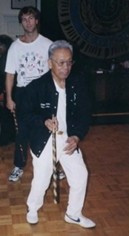
Grandmaster Jonathan M. Abaya, also known by his art name Jonathan "Makiling" Abaya, is the founder of Jendo Martial Arts, a Filipino system rooted in self-defense, flow, and a philosophy he called Tres-Energias ("Three-Forces"). Hailing from Mandaluyong, Metro Manila, GM Abaya introduced Jendo in 1973, blending traditional Arnis principles with new movement concepts and creating an entirely original FMA system.
Jendo incorporates a wide range of training tools: stick, knife, spear (bangkaw), balisong, soteco ring, and dulo-dulo, along with empty hand techniques, emphasizing economy of motion, inter-style fluidity, and combative practicality.
In 1984, GM Abaya introduced Ruweda, a sport-oriented component of Jendo, later known as AFC (All-Style Fighting Competition). Designed as a combative outlet for various martial disciplines, Ruweda featured structured floor exercises, weapon forms, and full-contact rules. It was publicly demonstrated in 1993 at the first Mandaluyong Metro Manila Invitational Martial Arts Tournament, a landmark moment for Jendo’s public emergence.
To support its growth and spread, GM Abaya founded the International Jendo Federation (IJF) in 2006 and later helped establish affiliate school networks in the U.S., Japan, and Italy. In 2007, under Jendo’s banner, he organized the 1st Asian Martial Arts Games in Manila, featuring Jendo Ring Sport alongside other combat arts, and received a special plaque from the World Organizer of Martial Arts for his efforts.
Grandmaster Abaya has been widely recognized in the martial arts community. In 2002, he was inducted into the Universal Martial Arts Hall of Fame in Biloxi, Mississippi, and has been awarded 10th degree red belt grandmaster rankings and lifetime memberships from numerous international organizations, including the World Organizer of Martial Arts, World Eskrido Federation, and International Grandmasters Society.
GM Abaya’s career extends into academia and the arts. He earned a Ph.D. in Asian Martial Arts Science in 2004, serves as a lecturer in institutions such as the Integrated College of Physical Education and Sports as well as San Beda College, and has worked as a stunt performer and fight choreographer in Philippine television and film.
Through his creation of Jendo, an art that bridges traditional Filipino weaponry with modern martial arts concepts, sport competition, and educational outreach, Jonathan Makiling Abaya has contributed a uniquely creative and scholarly expression to the global Filipino Martial Arts landscape.
Inosanto Kali
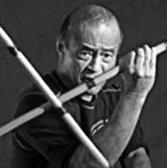
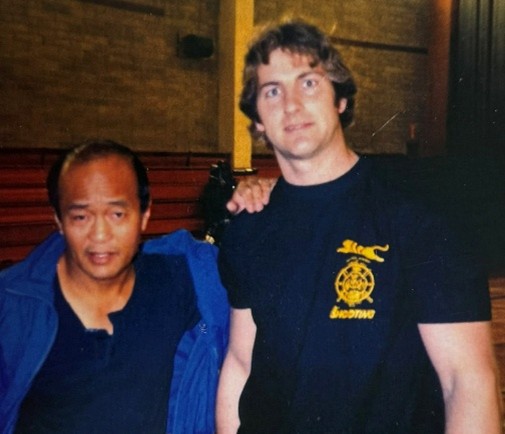
Dan Inosanto trained under many legendary FMA masters such as Angel Cabales, Leo Gaje, John Lacoste, Ben Largusa, and Antonio Ilustrisimo, synthesizing their teachings into a cohesive structure that highlights core Filipino principles, particularly angles of attack, weapon flow, trapping, and range transitions.
One of the hallmarks of Inosanto Kali is its methodology. Practitioners are trained in multiple weapon categories (single stick, double stick, dagger, sword, staff) as well as empty-hand components, all built on a foundation of timing, economy of motion, and responsiveness. Drills such as hubud-lubud, sumbrada, and sinawali are used not only for developing technique but for cultivating sensitivity and adaptability in real-time exchanges.
In keeping with the Jeet Kune Do philosophy of "absorb what is useful," Inosanto Kali emphasizes personal expression within a structured curriculum. Students are encouraged to adapt techniques to their own strengths and to explore the interplay between Filipino systems and other martial arts such as Muay Thai, Brazilian Jiu-Jitsu, Silat, and Wing Chun, plus Western boxing and wrestling.
Inosanto’s influence extends far beyond the FMA community. Through his seminars, writings, and tireless teaching at the Inosanto Academy of Martial Arts in Marina del Rey, California, he has introduced FMA to generations of practitioners around the globe. His students include military instructors, law enforcement professionals, Ultimate Fighting Championship competitors, and Hollywood stunt coordinators.
Inosanto Kali is often described as the "gateway" to FMA for many Western martial artists. Its blend of combat efficiency, cultural preservation, and artistic expression makes it one of the most dynamic and respected representations of FMA in the modern era.
Philippine Eskrima Kali Arnis Federation (PEKAF)
The Philippine Eskrima Kali Arnis Federation (PEKAF) is the official national governing body for Filipino Martial Arts in the Philippines, tasked with organizing, regulating, and promoting Arnis as both a sport and a cultural heritage. Founded in 2016 under the leadership of Senator Juan Miguel Zubiri, PEKAF was established to unify the many Arnis organizations under a single umbrella and to secure international recognition for the Filipino martial tradition.
PEKAF emerged following the passage of Republic Act 9850 (2009), which declared Arnis the national martial art and sport of the Philippines. While many groups had long promoted their own versions of FMA, the creation of PEKAF provided a centralized body to standardize rules, sanction competitions, and develop training programs at the grassroots and elite levels. Its mission reflects both the preservation of tradition and the advancement of Arnis as a competitive sport that can stand alongside fencing, judo, and taekwondo on the world stage.
A unique aspect of PEKAF’s work is its integration of Arnis into the Philippine school system. With Arnis mandated as part of the Physical Education (PE) curriculum, PEKAF oversees the certification and training of teachers to ensure that instruction is accurate, safe, and consistent nationwide. Physical Education teachers are required to undergo special training seminars and certification programs, where they receive instruction not only in the rules and techniques of Sport Arnis but also in the historical, cultural, and pedagogical foundations of FMA. This dual focus equips them to teach Arnis as both a competitive activity and a form of cultural preservation.
These certification programs typically include modules on technical proficiency in striking angles, forms (anyo), and sparring drills.



Sport Arnis
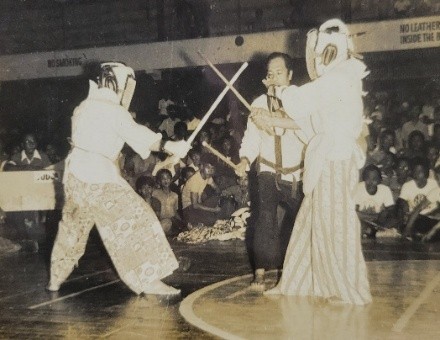
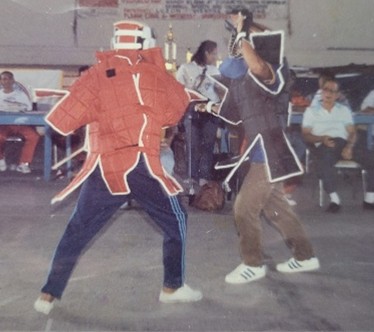
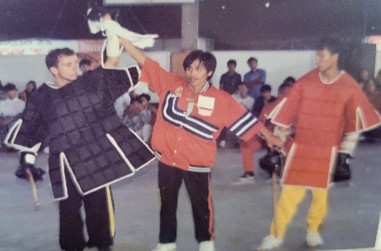
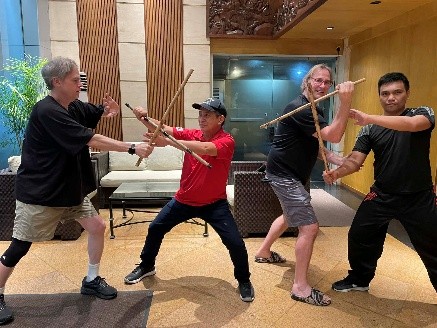
Recognized as the national martial art and sport of the Philippines in 2009 through Republic Act 9850, Sport Arnis transforms traditional FMA into a competitive discipline. Featuring padded sticks and protective gear, allowing practitioners to engage in full-contact sparring, Sport Arnis has gained popularity in schools and universities, promoting physical fitness, discipline, and cultural heritage among the youth.
Sport Arnis, whether in padded or live stick competition, represents one of the most visible and accessible expressions of FMA today. It emphasizes speed, timing, accuracy, and point-scoring within a rule-governed environment. While the movements resemble those of traditional systems, the motivations and constraints of Sport Arnis introduce significant differences, particularly when viewed through the lens of blade logic.
In competitive formats, target areas are clearly defined in Sport Arnis, often limited to the head, torso, or limbs, with strikes scored based on clean contact, visible intent, and control. Protective gear allows practitioners to spar at full speed, which encourages rapid-fire striking and evasive footwork. However, this also introduces a key shift: volume often replaces precision, and rhythm sometimes replaces strategy.
For example, a rapid succession of strikes to the helmet may earn points in Sport Arnis, but in a blade-based context, this flurry would be inefficient, as a single well-placed cut to a vital target would suffice. The use of a non-lethal stick in Sport Arnis allows players to stand in closer range than would be advisable in a live blade scenario. This shift can lead to habits such as exposing the weapon hand, overcommitting on entry, or neglecting disarms, which are dangerous if transferred directly to bladed combat.
Another key adaptation is the absence of trapping, checking, or limb control, which are often disallowed in point-based sparring to maintain flow and safety. These elements are core to many traditional systems, where weapon control is prioritized over hit-trading. The same is true of footwork strategy: Sport Arnis fighters may circle or bounce laterally for mobility, while blade systems emphasize angular displacement, body alignment, and positional dominance.
Still, Sport Arnis has tremendous value for the traditional practitioner. It develops reflexes, range awareness, pressure tolerance, and the ability to function under duress. These are all essential to real combat, and many systems encourage sparring in some form to test timing and application. However, for DTS and other blade-rooted styles, contextual framing is crucial. Practitioners must understand what is being trained and why, and avoid allowing point-scoring habits to override the deeper logic of survival-based movement.
Training in Sport Arnis alongside blade-based systems can serve as a stress-testing lab, provided the practitioner maintains clarity - the stick may be padded, but the intent of the movement must remain sharp. The empty-hand applications, angle logic, and body mechanics of a blade-based system should still inform how a practitioner closes distance, manages range, and finishes engagements, even in a ruleset designed to reward speed and volume over surgical precision.
In this way, Sport Arnis can be embraced not as a contradiction to traditional practice, but as a complementary environment, one that builds resilience and timing, while reminding the practitioner that every strike, whether with stick or blade, is guided by purpose, position, and principle.